

Every French judicial auction, scored and compared with its market before the hearing.

Enchèria compares the starting price of each sale published across mainland France with nearby notarial sales and with past awards, in order to estimate its market value, its discount and its probable hammer price, then sums up this analysis in a score from 0 to 100.

Get it on Google PlayDownload on the App Store

Sample analysis

Three-room flat, 64 m²

Sale following a property seizure

Enchèria score: 68/100

Excellent opportunity

Starting price
€140,000€2,188/m²
Estimated market valuemedian of comparable DVF sales
€249,600€3,900/m²
Discount of the starting price
-44%

Hammer price estimate

Low
€162,000
Probable
€215,000€3,359/m²
High
€255,000

The three pillars of the score

  • Property appeal40% of the score70
  • Market discount40% of the score64
  • Rental pressure20% of the score72
Illustrative figures for a fictitious property. In the app, every figure is calculated from comparable sales in the area and is not shown when these are too few.

What the app analyses

The app examines each sale from two angles, the score that places it among the sales on offer and the estimates that compare it with its market, then lets you follow the sales you select and cost their purchase.

The Enchèria score

Place a property among all the sales on offer

Each property receives a score from 0 to 100, which adds up three weighted pillars: the appeal of the property, which depends on its occupation and its type, the discount of the starting price and of the probable hammer price against the market, and the rental pressure of the town. The score therefore measures the interest of an opportunity, not its yield, and says nothing about the condition of the property or its legal situation, which only a visit and a reading of the conditions of sale can establish.
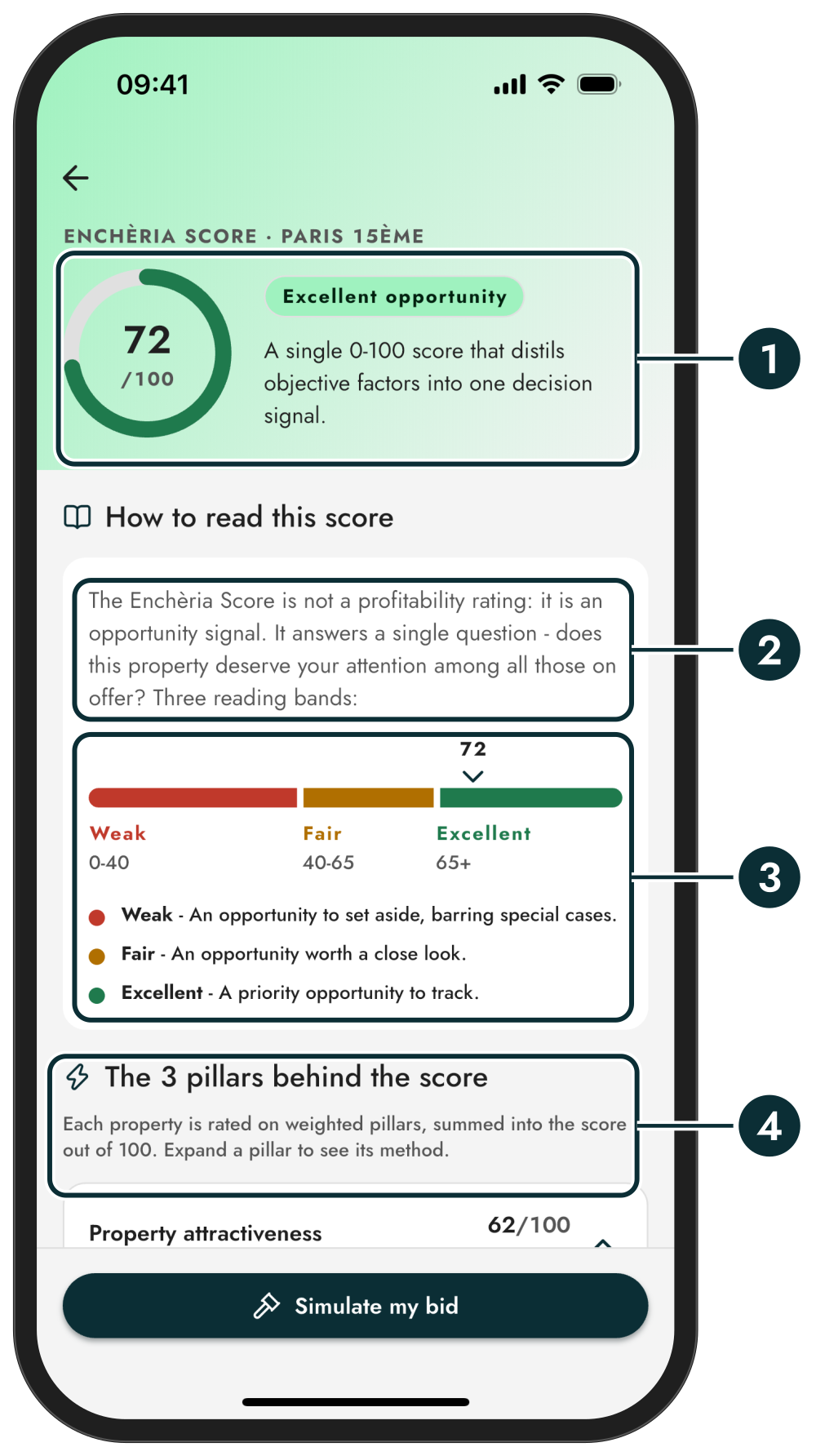
Detail page of the Enchèria score of a flat: 72 out of 100, what the score measures and the reading bands, from weak to excellent.
  1. The overall score out of 100, with its rating.
  2. What the score measures: an indicator of opportunity, not a measure of yield.
  3. The three reading bands, from weak to excellent, and where the property sits on that scale.
  4. The three weighted pillars the score adds up, detailed further down the page.
The estimates

Estimate the market value and the hammer price

The market value is estimated from the median price per square metre of notarial sales of properties of the same type within 500 metres, as the French State publishes them in the DVF data, and the discount compares the starting price with that value. The probable hammer price rests on the awards already made within two kilometres or, failing that, on the ratio observed in the département between hammer prices and market prices, a ratio from which the app also derives a low and a high estimate. These estimates are only shown when comparable sales are numerous enough, that is at least five nearby.

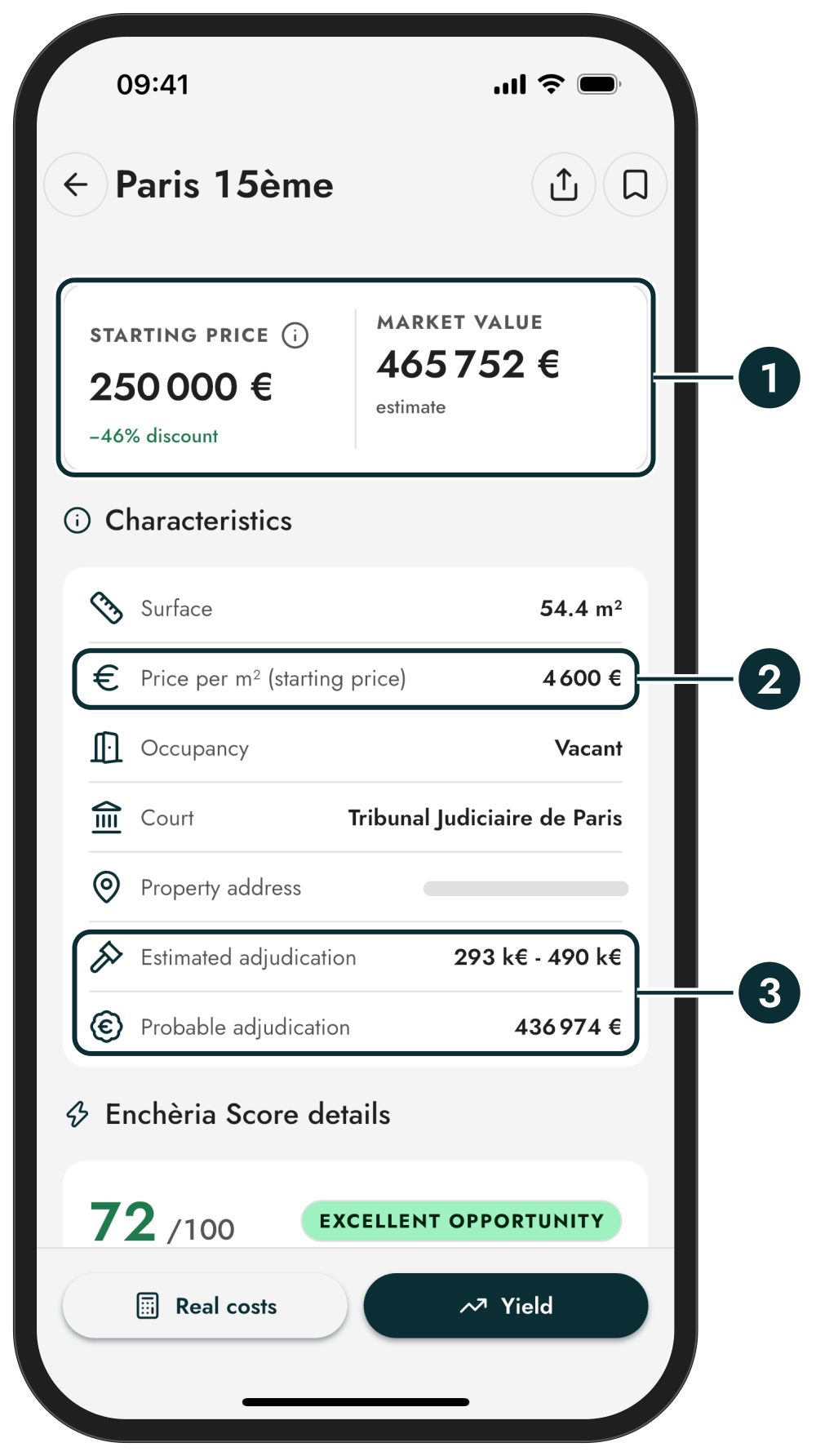
Property page in the app: starting price, estimated market value, discount, price per square metre, hammer price range and probable hammer price. The address of the property has been masked.
  1. The starting price, the estimated market value and the discount between them.
  2. The price per square metre of the starting price, to set against that of nearby sales.
  3. The hammer price range and the probable hammer price.

The Radar

Follow the sales that concern you

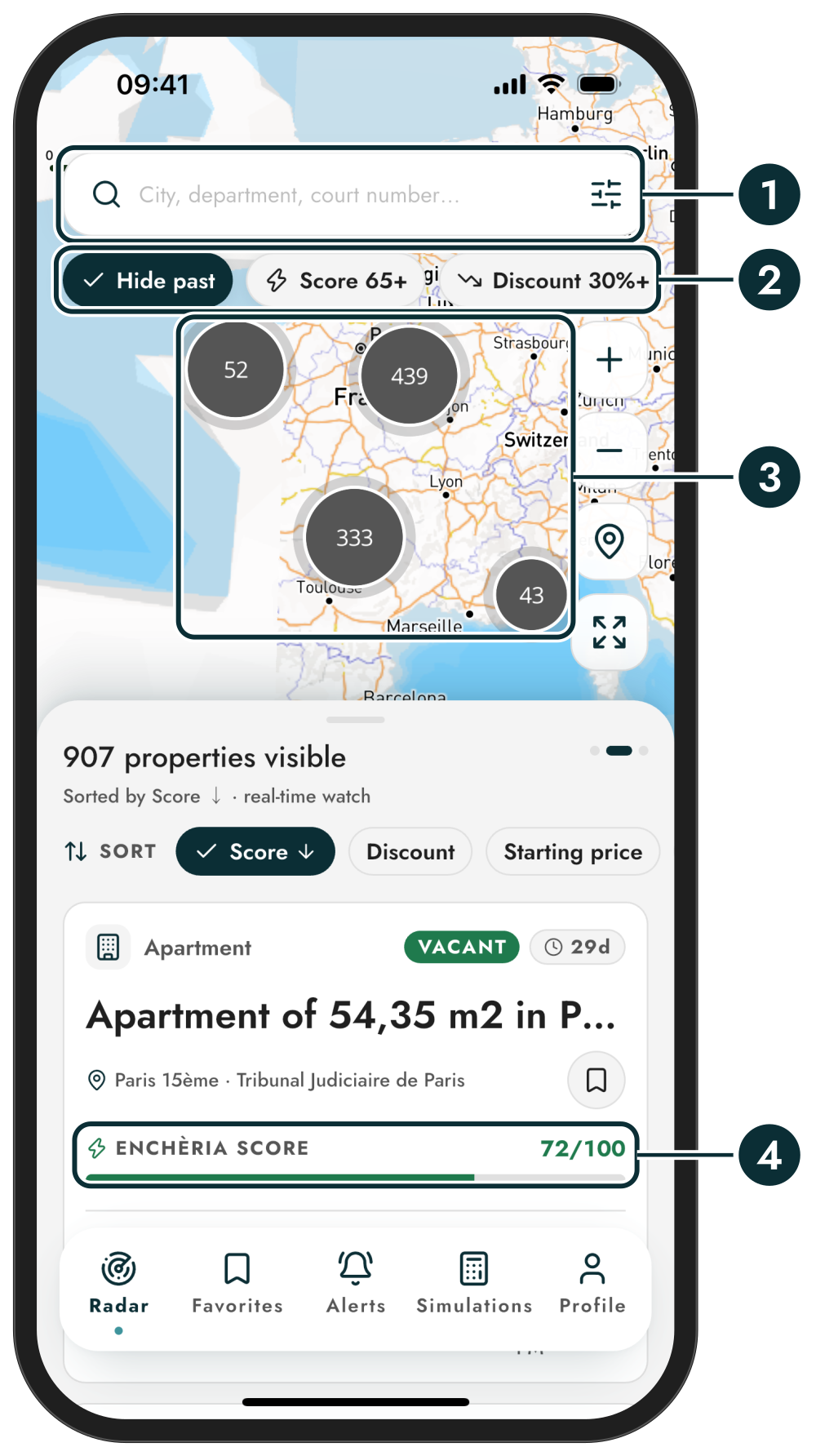
The Radar gathers the notices of the judicial courts, of commissaires de justice (judicial officers) and of legal notice journals, updated every two hours, and sorts them by score or by discount within the areas and criteria you set. When a new sale matches one of your radars, the app tells you through a notification or an email digest.

Radar screen of the Enchèria app: map of France with sales grouped together, quick filters and the list of properties sorted by score.
  1. Search by town, département or court number.
  2. Quick filters, which hide past sales or keep only properties above a score or a discount.
  3. Sales grouped on the map, with their count at each zoom level.
  4. The Enchèria score, shown on every listing.

The simulator

Extend the analysis to cost and yield

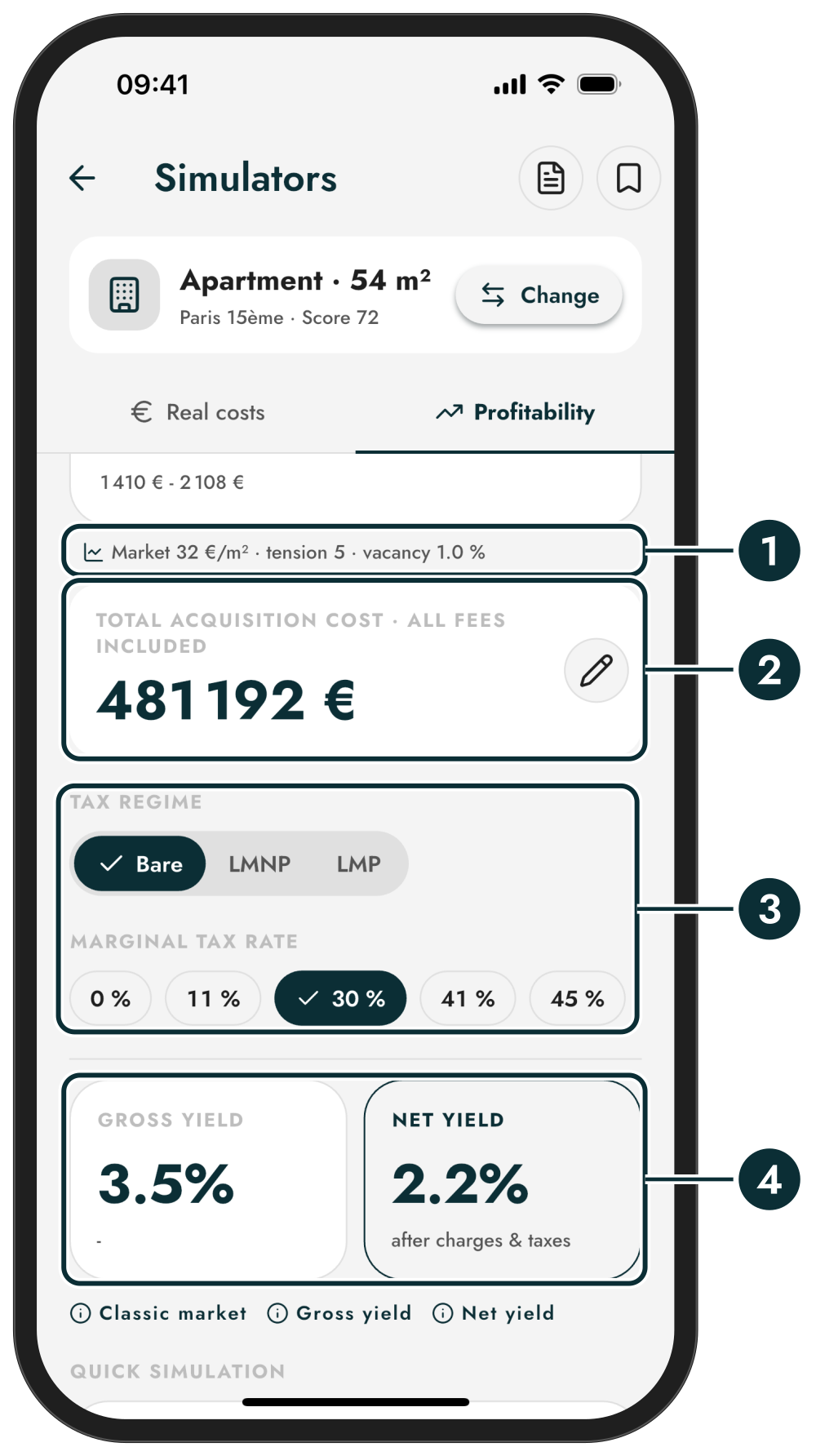
Once a property is selected, the simulator starts from the probable hammer price, which you can adjust, adds the preliminary costs, sale fees, transfer duties and land registry contribution, then estimates the gross and net rental yield from the market rent of the town under the chosen regime: unfurnished letting, LMNP or LMP. It is available with the Investor subscription.

Yield screen of the simulator: total purchase cost, tax regime, marginal tax rate and gross and net yields.
  1. The market rent of the town, used as the assumption for the calculation.
  2. The total cost of the purchase, all fees included.
  3. The chosen tax regime and marginal tax rate.
  4. Gross yield and net yield after charges and tax.

Where the figures come from

Enchèria's analyses rest on public data, cross-checked for each sale as soon as it is published, so that every figure can be traced back to its source.

Notarial sales
The DVF data (demandes de valeurs foncières), published by the French public finance directorate, lists property sales over recent years; Enchèria derives from it the median price per square metre of comparable properties within 500 metres.
Past awards
Awards made by the courts also appear in this data, which makes it possible to measure, area by area, the gap between the price obtained at the hearing and the market price, and to infer the probable hammer price.
Rents of the town
The indicators of the rent map published on data.gouv.fr give the market rent of each town, graded in five levels, which feeds the rental pressure of the score and the yield calculation.
What the figures do not say
An estimate remains a median: it takes no account of the condition of the property, its floor, or the charges and easements revealed by the conditions of sale, and it is not shown when comparable sales are too few to be reliable.

How a sale unfolds

A judicial auction follows a procedure set by the French Code of Civil Enforcement Procedures, whose steps always come in the same order.

Read the full guide

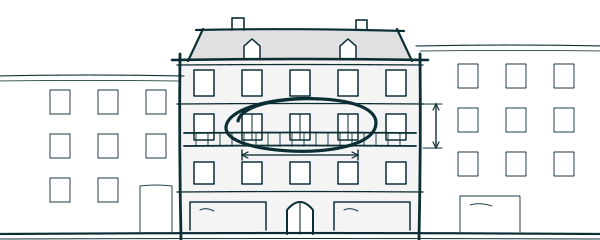
Sketch of an auction hearing: before the enforcement judge, two lawyers in gowns, one of them raising a hand to bid.
  1. Before the hearing

    1. One to two months before

      Publication of the sale

      The sale is announced in a legal notice journal, and the conditions of sale, which describe the property and the rules of the sale, can be consulted at the court registry or at the seizing creditor's lawyer.

    2. On the date given in the notice

      The visit

      A commissaire de justice organises the visit on a date fixed in advance, and there is often only one.

    3. A few days before

      The lawyer and the guarantee

      You instruct a lawyer registered at the bar of the court and hand them a guarantee equal to 10% of the starting price, at least €3,000, with your financing already secured.

  2. On the day of the hearing

    1. Before the enforcement judge

      The award

      The lawyers bid upwards from the starting price, and the property goes to the last bidder once ninety seconds pass without a new offer.

  3. After the hearing

    1. Within ten days

      The overbid

      Anyone may still offer a price at least 10% higher, which leads to a new hearing.

    2. Within two months

      Payment

      The successful bidder pays the price and the costs of the sale; failing this, the property is put back up for sale at their expense.

Guides

The guides explain how to read the score and the estimates, then go through each step of the procedure in detail.

All guides

Download Enchèria

The app is available on Google Play and on the App Store.

Get it on Google PlayDownload on the App Store

L’enchère, en clair.